Why We Chose to Keep the Holub Name (and What It Represents)
When a historic building changes hands, the first instinct is often to rebrand. New owners. New website. New story. A clean slate.
We considered that.
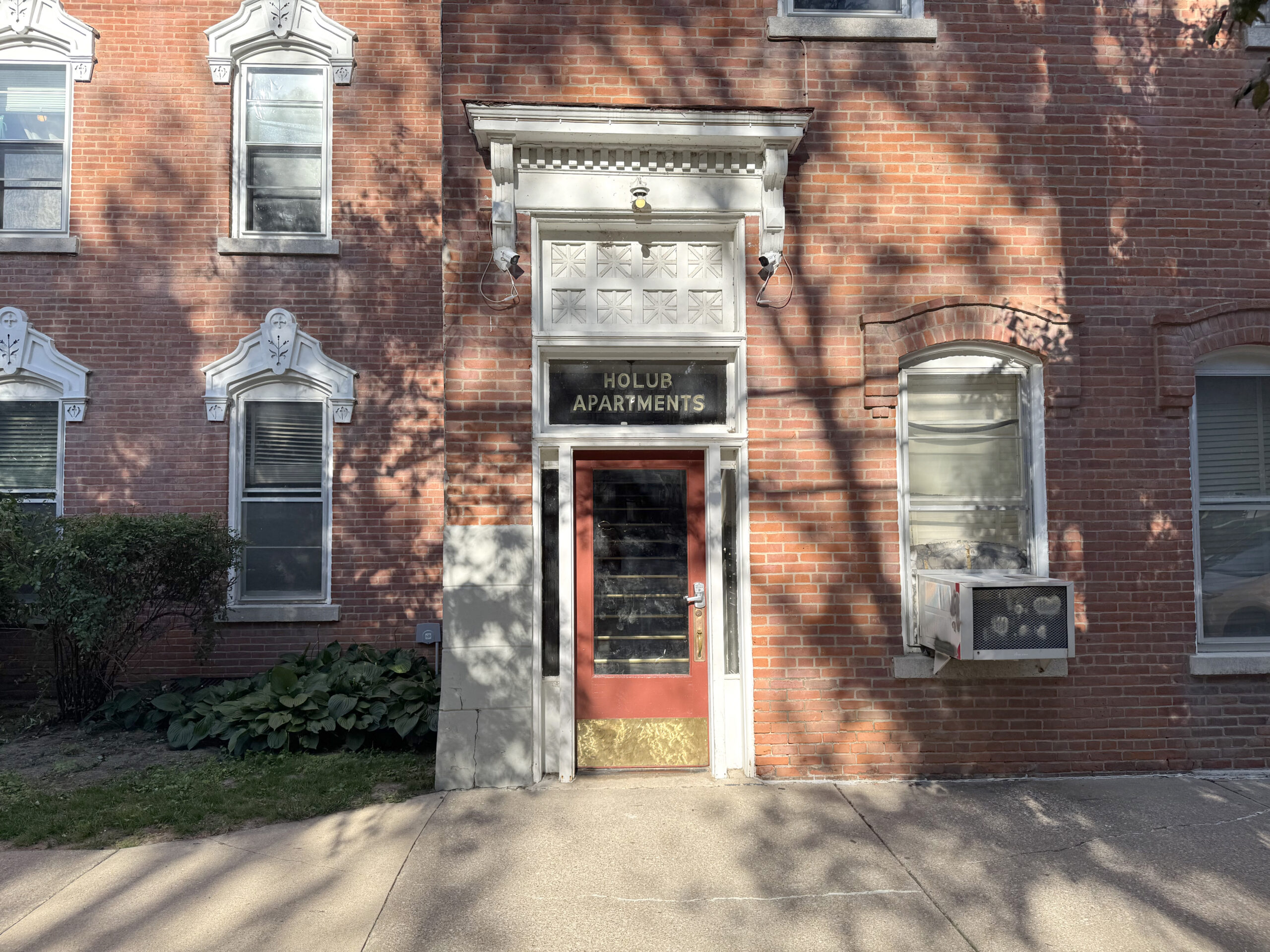
Then we looked at the building itself — the brick, the Italianate details, the second-floor hall that once filled with polka music and Czech fraternal meetings — and it became obvious that a new name would have been the wrong kind of “new.” This place already has a name that belongs to it. Holub is not a marketing invention. It is part of how Iowa City has known this corner for more than a century.
So we kept it.
The name was already here
The story of this property does not start with apartments. It starts in 1875, when Joseph Slezak completed the original brick building at Bloomington and Linn as Slezak’s National Hall — Národní Síň — a gathering place for Iowa City’s Bohemian community. Ground floor: store and tavern. Upstairs: dances, lodge meetings, entertainments, even a polling place during the nation’s centennial year.
The family that built it stayed. Six generations of the extended Slezak line stewarded the complex. In 1892, Joseph Slezak’s daughter Anna married Joseph F. Holub. From that point, much of the daily operation shifted to the Holub side of the family — Holub & Son, a farmers hotel, grocery, and the everyday commerce that made this corner a destination for people coming into town.
That is why older photographs and local memory still say “Holub Hotel and Store.” The building later became known to many as the Pagliai’s building, and it is also correctly called the Slezak-Holub-Skarda complex. All of those names are true. Holub is the one that sits in the middle of the family story — the generation that turned a national hall and hotel into a long-running neighborhood business, then into apartments above shops that still serve the Northside today.
Keeping the name is a way of saying: we are not starting from zero. We are continuing a line.
What “Holub” actually means
Holub is a Czech (and Slovak and Ukrainian) surname. It means dove.
That is not a coincidence we invented for a tagline. It is the word itself. In Czech culture the dove has long carried associations of peace, homecoming, and a mild, steady character — the opposite of flash. For a building that began as a hall where immigrants kept language, music, and mutual aid alive while learning a new country, the meaning fits.
A dove does not announce itself. It returns to the same place. That is closer to how this property has actually worked: grocery, hotel, pizza, laundry, apartments, landmark designation, renovation. Different uses. Same corner. Same job of holding a neighborhood together.
We liked that more than a invented “Northside Lofts” or “Linn Street Residences” ever could.
A name is a form of stewardship
In 2023–2024 this building was at real risk. It went on the market. Demolition was a plausible outcome. Historians, Friends of Historic Preservation, the National Czech & Slovak Museum & Library, neighbors, and the City of Iowa City fought for it. On May 21, 2024, the City Council voted 7–0 to designate the Slezak National Hall Complex a local historic landmark.
That fight was not about a pizza restaurant, though Pagliai’s is part of the living building. It was about a rare surviving piece of Czech-American civic architecture in Iowa — a hall, hotel, store, and home that still stands.
New ownership could have treated landmark status as a constraint and the old family names as clutter. We treat them as the reason the work is worth doing.
Brian Decoster and James Thibodeau did not inherit this property. They chose it. Choosing to keep Holub is part of that same decision: the building is not a blank canvas. It is a responsibility. The apartments we are renovating — high ceilings, original character, central air that does not destroy the architecture, secure entry, laundry under the same roof — are updates. The name is continuity.
Residents should feel that difference. This is not a corporate product with a lifestyle logo. It is a landmark with new kitchens.
What the name represents now
For us, Holub stands for four things that are not nostalgic slogans. They are operating principles.
Continuity over erasure. Iowa City does not need another renamed student box. It needs owners who can say whose hall this was, whose grocery this was, and why the brick is still here.
Community as the original use. The second floor was never “extra square footage.” It was Národní Síň. The building’s first job was gathering. Apartments, Pagliai’s, and Laundromania are later chapters of the same idea: people live, eat, wash clothes, and run into each other on one block.
Care that is local and personal. The site copy says “proud Northside caretakers” because that is the standard. Landmark buildings fail when they are treated as assets first and places second. The Holub name reminds us which order is correct.
Peace as a practical value. A dove is not dramatic. Neither is good management: smoke-free common areas, working heat and air, hallways finished with respect, someone who answers when something breaks. That is the unglamorous version of what the name means.
Why not Slezak? Why not Skarda? Why not something new?
Slezak is the founding name. Skarda is the later family name many locals still associate with ownership before the sale. Both deserve to stay in the history — and they do, on our history page and in every honest account of the complex.
Holub is the name that already lived in the middle of daily life here: hotel, store, “Holub & Son.” It is pronounceable, already attached to the building in period photos, and distinct from the restaurant that leases the ground floor. Using it lets us honor the family chain without pretending the new owners are Slezaks, and without flattening 150 years into “the pizza building.”
A brand-new name would have been easier to trademark. It would also have been a small act of forgetting. After a public landmark fight, forgetting is the one thing this corner cannot afford.
The name on the door, the work in the walls
Keeping Holub does not mean freezing the building in 1892. The hallways are being rebuilt. Units are being remodeled. Systems the original hotel never had — quiet central air, keypad access, cameras in common areas — are going in because residents in 2026 should not have to choose between character and comfort.
The point of the name is to keep those two efforts in the same sentence. Renovation without memory is just construction. Memory without renovation is a plaque on a deteriorating shell. Holub Apartments is an attempt to do both.
If you live here, or you are considering it, you are not renting a concept. You are renting a floor of a building that has already been a national hall, a farmers hotel, a grocery, a home for generations of tenants, and now a designated landmark. The name on the site is the short version of that sentence.
Holub means dove. Here, it also means: we kept the name because the building earned it, and because the next chapter should still be recognizable as the same story.
Ready to see the apartments as they come online? Browse current units or contact us to schedule a tour. Welcome to the Northside.